
Silent Spaces
In Praise of Piero della Francesca
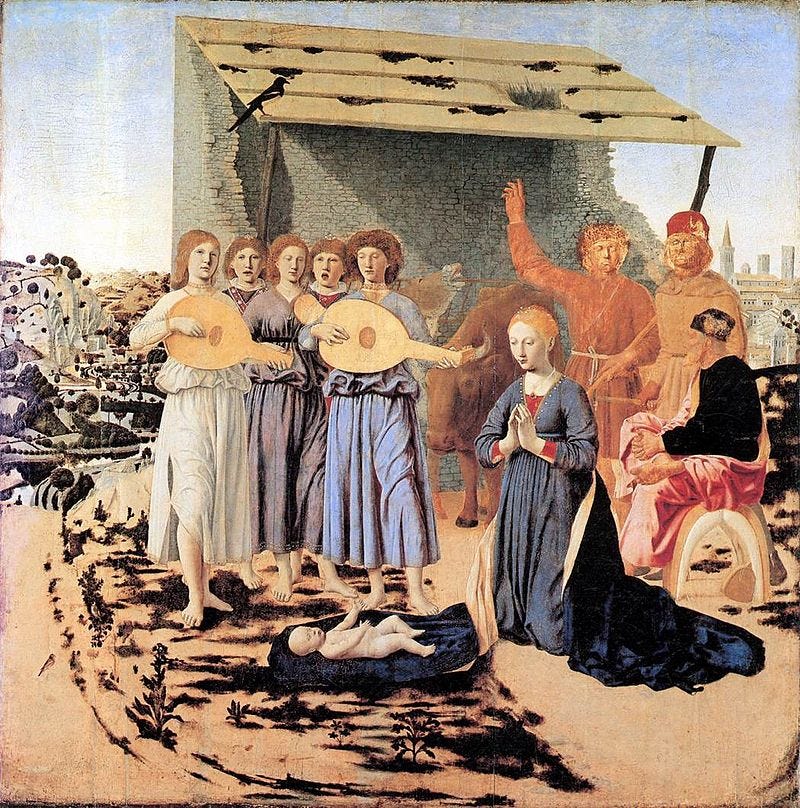
Encouraged by a friend, I recently saw this painting, The Nativity by Piero della Francesca, for the first time. I could look at it for hours and no doubt that was the intention, as the Italian master apparently hung it on the bedroom wall of his palace. How he must have gazed upon it with feelings of joy, just as we do, as he laid in bed with the Tuscan dawn or dusk turning the motes of dust between into shimmering flecks of gold. This is of course my imagination. But that such a quieting image comes to mind is the effect of the painting upon the viewer which encourages contemplation, not necessarily of the image – beautiful and glorious though it is – but of the infinite, silent spaces beyond. It is almost as though Piero crafted the image from space and time itself, but left the uncreated potential of the universe within the frame. It is toward that infinitude of silent spaces that one’s vision wanders.
But the eye is first drawn to the figures. The five angels, two with lutes. The holy family, Mary kneeled in contemplation of the Christ child, Joseph with one leg hooked nonchalantly over the other. Two proud-looking shepherds. The magpie perched upon the tumbled-down roof. The braying oxen. The countryside, hot and spare, redolent of cedarwood and manure. The town behind with spires and terracotta roofs, transmuted into Bethlehem. Everything is frozen, suspended, motionless. Even the tiny goldfinch, an onlooker, unmoving. The angels on the very cusp of song. As though the sound of the instruments were about to shatter the wall between us. But the sound is only of silence. The feeling at first is almost melancholy. It is only a painting in the end. Paintings cannot sing. Nor can they burst into life. One can only imagine the profundity of Piero’s melancholy, knowing he is, after all, only a man and this is only the work of human hands. There is no such thing as angels or miracles. Christ did not rise from the dead. Both painting and painter are destined to become dust.
Until we become aware of what lies beyond the immediate. That the painting – perhaps like the sensual world itself – is a mysterious veil through which the actual truth of our experience might be glimpsed, just beyond reach. But the veil is also the truth. Does the Greek word mustḗrion, from which we derive the word mystery, not originally mean the silence of the initiate given access to the secret? The painting gives us access, too. Access to the truth that moves between the words of the Bible. That compelled Abraham to welcome three strangers out of the noon-day heat. That found Rebekah at the well. That bid Ruth lay down upon the threshing-floor. Simplicity beyond measure. The essence of Christ’s beatitudes. Words that compel all others to be silent. We find the same spirit in many great works of religious art. In Giotto. In Rembrandt. In Millet. But especially in Piero. The baptism. The resurrection. Even the flagellation. The infinite, silent spaces beyond this world.
Ezekiel David is a writer who lives in Athens